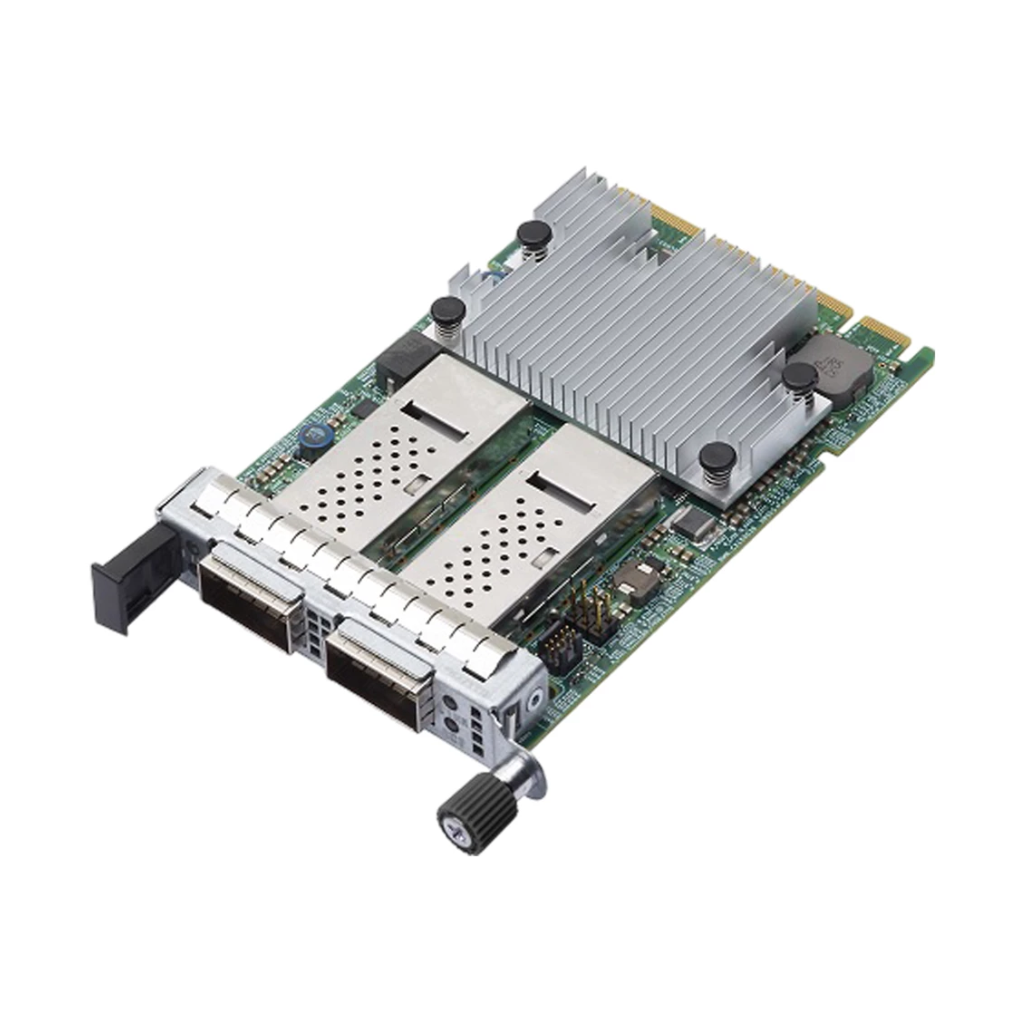
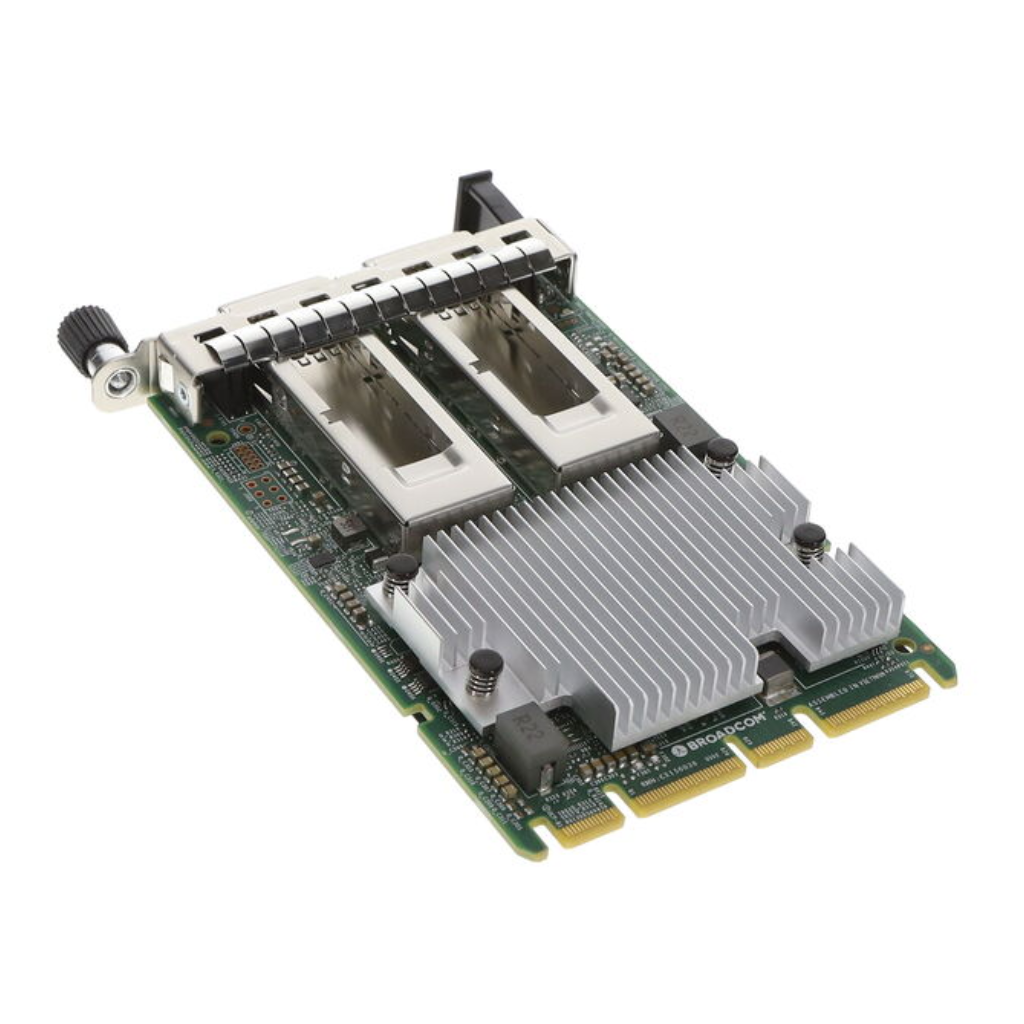
Broadcom Dual-Port 100 Gb/s Ethernet PCI Express 4.0 x16 OCP 3.0 SFF Network Adapter
Factor : OCP 3.0 card (PCIe 4.0 ×16)
Ports : 2 × 100 Gb/s QSFP56
Connectivity : Wired Ethernet (QSFP56 fiber or DAC cable)
Speed / Protocol : 10 GbE, standard Ethernet
Features:
- 100 GbE, full-duplex
- Supports QSFP56/QSFP28 modules
- Advanced offloads (checksum, LSO/TSO), SR-IOV, RDMA
- Jumbo frames up to ~9 KB
- PXE / UEFI / iSCSI boot support
| Ports: 2 × 100 Gb/s QSFP56 |
| Form Factor: OCP 3.0 card (PCIe 4.0 ×16) |
| Device Type: Network adapter |
| Speed: 100 GbE |
| Connectivity: Wired Ethernet (QSFP56 fiber or DAC cable) |
Overview
The Broadcom BCM957508-N2100G is a high-performance dual-port 100 Gb/s Ethernet OCP 3.0 network adapter designed for next-generation data centers, cloud platforms, and high-throughput enterprise applications. Built with PCIe 4.0 ×16 bandwidth and QSFP56 connectivity, it delivers extremely low latency, massive throughput, and advanced virtualization features for demanding workloads such as AI, HPC, storage acceleration, and large-scale virtualization.
Key Features & Detailed Analysis
1. Dual 100 Gb/s QSFP56 Ports
- Provides 2 × 100 GbE full-duplex high-speed connectivity
- Supports QSFP56 for 100 Gb/s and QSFP28 for 25/50 Gb/s compatibility
- Works with fiber-optic modules or direct-attach copper (DAC) cables
- Ideal for top-of-rack, spine-leaf, and high-speed fabric environments
2. OCP 3.0 Form Factor (PCIe 4.0 ×16)
- Optimized for modern cloud and hyperscale server chassis
- PCIe 4.0 ×16 ensures maximum bandwidth for 100 Gb/s performance
- Lower power consumption and better airflow efficiency with OCP 3.0 SFF design
3. Advanced Networking & Acceleration
- Hardware offloads: checksum, LSO, TSO for CPU efficiency
- SR-IOV for large-scale virtualized environments
- RDMA (RoCE/iWARP) support for ultra-low latency workloads
- Jumbo frames up to ~9 KB for efficient large-packet transmission
- Designed for minimal latency and maximum packet throughput
4. Boot & Storage Support
- Supports PXE boot, UEFI boot, and iSCSI remote boot
- Suitable for diskless servers and SAN-based infrastructure
5. Enterprise & Cloud Compatibility
- Engineered for hyperscale cloud servers, AI clusters, and high-performance storage networks
- Delivers reliable and consistent 100 GbE connectivity
Target Use Cases
1. High-Performance Data Centers & Cloud Providers
- Perfect for 100 GbE top-of-rack and spine-leaf architectures
2. AI/ML, HPC & GPU Clusters
- RDMA support enables low-latency communication for large cluster workloads
3. Virtualization & Cloud Platforms
- SR-IOV ensures efficient VM-to-network performance
4. High-Speed Storage Networks
- Ideal for NVMe-oF, distributed storage, and iSCSI SAN environments
5. Large-Scale Enterprise Applications
- Designed for massive data movement, analytics, and high-bandwidth workloads
Summary
Strengths
- Dual-port 100 Gb/s QSFP56 for ultra-high throughput
- PCIe 4.0 ×16 and OCP 3.0 ensure maximum performance and efficiency
- Supports QSFP56/QSFP28 modules and DAC cables
- Advanced virtualization (SR-IOV) and low-latency RDMA capabilities
- Jumbo frame support (~9 KB)
- PXE, UEFI, and iSCSI boot for flexible deployment
Considerations
- Requires OCP 3.0 server compatibility
- QSFP56/QSFP28 transceivers or DAC cables are not included
- Designed for enterprise and hyperscale environments, not small office setups
Conclusion
The Broadcom BCM957508-N2100G delivers extremely fast, low-latency dual-port 100 GbE connectivity with advanced hardware offloading, RDMA support, and PCIe 4.0 bandwidth. Its OCP 3.0 form factor makes it ideal for high-density, high-performance servers in data centers, AI clusters, virtualization platforms, and modern storage networks.